

What M/NVE Is - And What It Isn't

AI Generated Illustration
A network of youth, scattered across the globe, communicates through encrypted chat rooms. The price of entry into the inner circles of these communities is to commit a violent or criminal act and to share evidence of having done so. The acts range from minor vandalism through coerced self-harm and suicide to, at the most extreme, mass violence. These communities have been described in many ways; at times they’re called 764, at times The Com - in reality, neither captures the full extent of complex dynamics within this ecosystem.
The phenomenon is recent enough that researchers and governments still disagree about what to call it. The disagreements matter because each name carries assumptions about what response is possible and whose responsibility it is to grapple with it. At Revontulet, we describe the phenomenon as Misanthropic and Nihilistic Violent Extremism, or M/NVE, an increasingly adopted term. In this piece, and across the resource series it opens, we set out what M/NVE is, and just as importantly, what it is not.
One thing should be flagged at the outset. We do not reproduce imagery, content, or aesthetic material drawn from M/NVE communities anywhere in this resource series. This is a deliberate choice. Sensationalist treatment of this material is something we have observed across journalistic coverage, in law enforcement settings, and policy contexts. The underlying dynamic quickly becomes the same in each: detailed reproduction of the communities' visual register, whether under the cover of analysis or warning, tends to amplify the material and to lend it the cultural standing the communities themselves seek.
In our coverage and public-facing materials, we aim not to reproduce imagery associated with the groups and encourage the journalists, researchers, and policymakers who use this resource to adopt the same stance. The point applies as much to investigative slide decks and press conferences as it does to news coverage. Marveling at the imagery, however the marveling is dressed up, is part of how the imagery spreads.
The working definition
M/NVE is the term researchers and several governments have started using for a transnational set of online communities, loosely connected through encrypted messaging platforms and unregulated forums. The members of these communities blend misanthropy, the worldview that human existence has no inherent value, with the operationalization of that view through nihilism, the rejection of meaning that lets the worldview act on the world. Communities work in a register that fuses celebration of mass-casualty attacks, sextortion, animal abuse, coerced self-harm, and coerced suicide. The most often-cited groupings are the Com network, with branches such as 764, No Lives Matter, and Maniac Murder Cult, alongside adjacent influences from esoteric neo-nazi groups such as the Order of Nine Angles, and more traditional accelerationist and neo-nazi communities, including Atomwaffen Division, The Base, and the Terrorgram Collective.
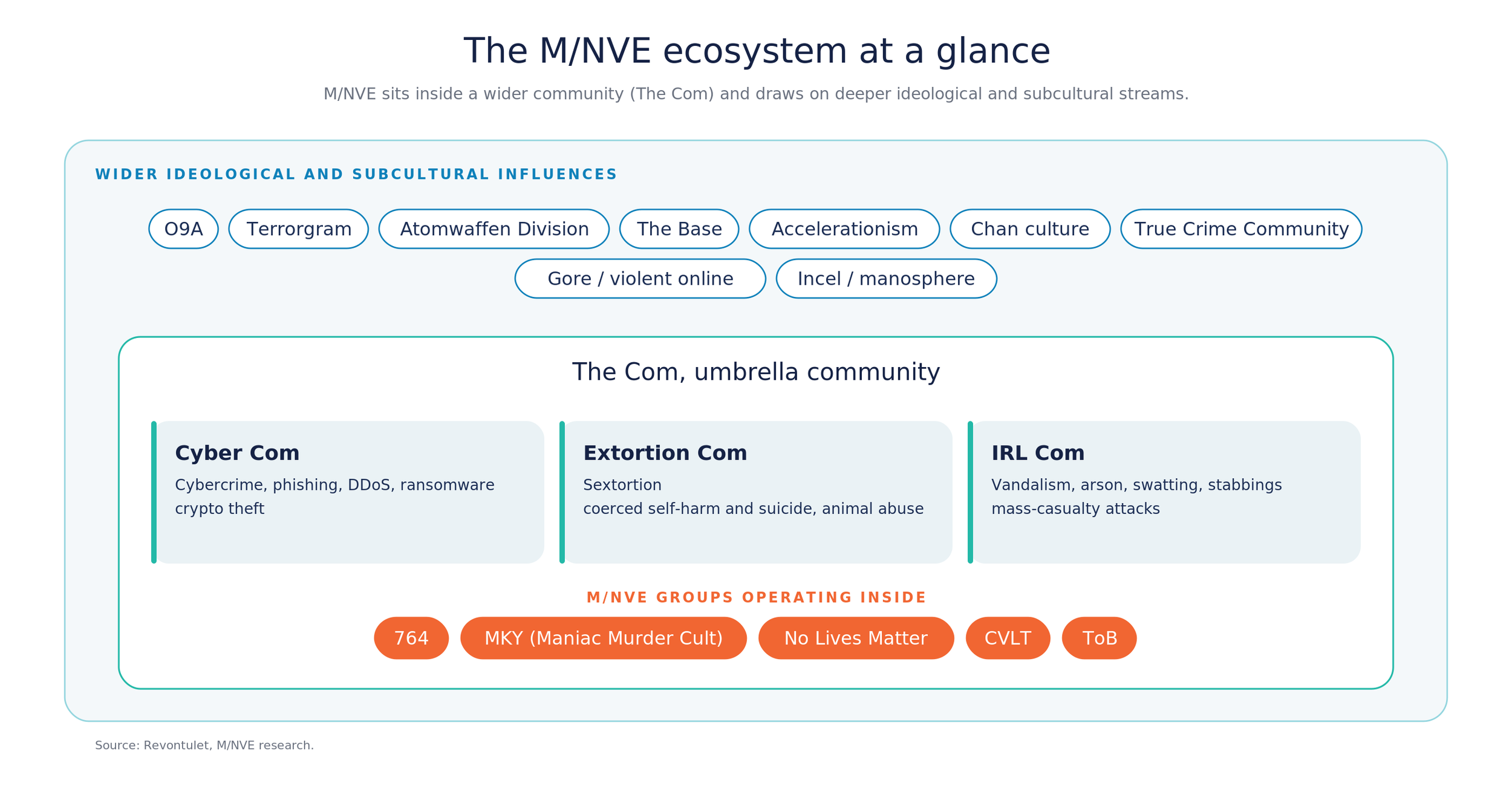
Figure: M/NVE sits inside the wider Com community, which itself draws on a constellation of older ideological and subcultural influences. The orange chips at the bottom are just some of the named groupings most often associated with the M/NVE label - there are many more.
Multiple jurisdictions now formally recognize the phenomenon. The US Department of Justice adopted "nihilistic violent extremism" as a classifying term in April 2025, and the FBI describes 764 as a Tier One priority threat with investigations across all 55 of its field offices. Canada listed 764, Maniac Murder Cult, and the Terrorgram Collective as terrorist entities in December 2025; New Zealand designated the Order of Nine Angles and the Terrorgram Collective the same month; Australia listed the Terrorgram Collective in June 2025. The UK has prosecuted 764-linked offenders under terrorism legislation, and Dutch counter-terrorism authorities use the Dutch term nihilistisch geweld for the same phenomenon.
What M/NVE is not: the easy mistakes
It is not "violence without ideology." Some early descriptions of nihilistic violence framed it as extremism without an ideological core, distinguishing it from the utopian programs of jihadist or white-supremacist movements. This framing was problematic. A more precise way to describe it is, as we have, that M/NVE is dystopian, not non-ideological. Classical extremist movements pursue a desired end state, whether the white ethnostate, the Caliphate, or the workers' state. M/NVE pursues something different: the collapse of society under the weight of its own violence, and the demonstration that human existence has no inherent value. The objective differs from the utopian one in content rather than in kind, and the practical consequence is the same: a worldview enacted through violence, organized and sustained by communities that share the worldview.
The framing matters because it shapes our approach to tackling the issue. If nihilistic violence is read as purely aesthetic rather than ideological, the manifestos and group structures begin to look incidental, peripheral to the real action; read as a dystopian program, those same features turn into the visible operating layer of the phenomenon, giving us the tools in policy, law enforcement, and civil society to employ established law and structures to support victims and prevent harm.
It is not the True Crime Community. (EDIT: When we say "True Crime Community" here, we mean the online subculture sometimes called Columbiners and its descendants, focused on perpetrators of mass violence and serial killers as figures of fascination, not the much broader audience for true-crime podcasts and documentaries.) Online "true crime" interest is a much broader phenomenon, with most participants drawn by ordinary curiosity rather than anything that rises to the level of extremism. There is a documented overlap. M/NVE recruiters use true-crime communities as a place to find isolated young people, and a small share of cases show that as a pathway for radicalization. The connection is real, but the conflation is problematic. Getting it wrong in either direction tends to produce the same kind of mistaken response: either a too-broad sweep against “ordinary” true crime communities or a too-narrow focus that misses the recruitment channel running through them.
It is not ordinary self-harm. Within M/NVE communities, members and victims at times produce "cutsigns": self-inflicted cuts forming letters, numbers, group initials, or the handles of specific community members. They look superficially like the patterned wounds associated with depression and other mental-health conditions, but the meaning is different. A cutsign is an artifact of coercion, a loyalty signal, not only an expression of psychological distress. The young person carving it has been instructed to do so and has often been instructed to photograph or live-stream the result for someone else. That changes the clinical and safeguarding response in important ways: separating the young person from the coercive group dynamic, identifying who commissioned the cut, and preserving the imagery as evidence rather than treating it primarily as a symptom. Practitioners working with young people should be aware of the difference, even if any given case takes time to clarify itself.
It is not "edgy teenage humor." Much of the content M/NVE communities produce arrives wrapped in irony, meme grammar, and explicit "just a joke" framing. That framing is doing work. It lowers the defenses of new arrivals, provides plausible deniability when content is flagged, and gives the community a shared in-group register that is hard for outsiders to read. The communities themselves do not treat the content as a joke; the same images that read to a casual observer as low-effort shock humor function within the community as recruitment material, coercive instruction, and celebration of real-world violence. The combination of the two registers is part of what keeps the ecosystem both deniable and effective.
It is not generic accelerationism. Accelerationism in the broader sense is the idea that societal collapse should be hastened. Many movements have used some version of this idea, on different parts of the political spectrum and in different historical moments. M/NVE is connected most directly to the militant accelerationism associated with neo-Nazi networks, and to the Order of Nine Angles' nihilistic strand specifically. The overlap with right-wing terrorism is real but not total.
Many participants pull material from neo-Nazi sources, occult traditions, and misanthropic literature into a personal worldview that does not conform to any of the existing ideological categories cleanly. AsLindsay and Argentino have argued, the legacy branding of designated groups, including Atomwaffen, The Base, and the Order of Nine Angles, is co-opted in Com networks less as evidence of doctrinal commitment and more as currency in an attention economy where notoriety and transgression operate as subcultural capital. A young person carving an O9A sigil into their arm may not be an O9A initiate in any meaningful sense; the sigil is performing status work within a network that runs on shock value.
What makes M/NVE distinct is not only its ideological lineage but the intersections it produces, sitting at the meeting point of violent extremism, child sexual abuse material, and computer crime, with older ideological branding supplying aesthetic vocabulary and status markers rather than political program. The category is messy enough that any analysis has to hold two ideas at once: that M/NVE shares much of its symbolic and political vocabulary with right-wing extremism, and that lumping them together obscures the specifically intersectional features that make the M/NVE register distinctive.
It is not a group you can join. M/NVE is not a hierarchical organization with leadership, membership cards, or stable structures. It is a constellation of overlapping online communities, and a young person who participates in 764 is not a member in the way someone is a member of a political party or a designated cell of an older terrorist organization. Participation runs along an internal status ladder defined by what someone produces: cutsigns, bloodwalls, coerced material from victims, and, in some cases, attacks. The shape matters for how interventions work, because the techniques built for hierarchical groups, focused on identifying and removing leadership, do not map onto a network where the center keeps shifting and where every participant is, in some sense, their own producer.
What M/NVE is: the features that recur
Recruitment through vulnerability. Recruiters seek out young people in spaces associated with self-harm, eating disorders, gender-related distress, depression, and isolation. The pattern of contact runs through lovebombing and progressive escalation, with grooming techniques that overlap closely with what is documented in child sexual exploitation cases. Researchers studying the recruitment dynamic have described its general stages, though the timelines and specific tactics vary. Most young people who encounter M/NVE content never become participants. Those who do tend to share a profile of social isolation, prior victimization, and unmet emotional or social needs that the network appears, at first, to meet.
Status earned through documented violence. Participants advance within communities by producing content that demonstrates commitment: cutsigns, "bloodwalls" (writing on walls in what appears to be blood), coerced material from victims, animal abuse, and, in some cases, physical attacks. Researchers, including the Canadian Anti-Hate Network and the Institute for Strategic Dialogue, have described the underlying principle as "action equals membership, content equals status." Once that logic is in place, escalation tends to become the norm. New material has to do more than what came before, partly because the community's attention is finite and partly because each new contribution has to earn its keep against everything already on the wall.
Sustained coercion of victims. A defining practice is the "lorebook": a per-victim dossier compiled over weeks or months, combining intimate imagery (often coerced), identifying information about the victim, and material on their wider social circle. The lorebook serves as ongoing leverage and a barrier to disclosure, as the threat of releasing it keeps the victim compliant. Removing individual components does not neutralize it; the compilation as a whole is what does the coercive work, and effective intervention generally requires reaching the master copy held by the controlling group rather than chasing leaked excerpts.
Cross-platform mobility. M/NVE communities are not platform-specific. They use mainstream platforms (Discord, Telegram, gaming services, social media) for the recruitment surfaces where new participants come into contact with the ecosystem, encrypted channels for operational coordination among existing participants, and a wider ecosystem of unregulated forums and content hosts for archival and distribution. Action against any one platform tends to displace activity rather than end it; participants migrate to the next available surface, often in coordinated fashion, with the rehoming announcements themselves becoming a routine part of community life.
Connection to real-world violence. M/NVE is not only an online phenomenon. Documented cases from 2024 and 2025 alone include the August 2024 mass stabbing in Eskişehir, Turkey; the January 2025 high-school shooting in Antioch, Tennessee; the December 2024 shooting at a Christian school in Madison, Wisconsin; the Hamburg "White Tiger" coerced-suicide network case; the indictment and 2025 guilty plea of the Maniac Murder Cult leader in New York; the November 2025 mosque bombing at a Jakarta school; and multiple Dutch prosecutions. Each case has its own profile, and the differences among them are real. Still, they share enough features in their online dynamics, including recruitment patterns, the use of livestreaming and manifesto distribution, and the saint-card and martyr conventions, that researchers have come to treat them as part of a recognizable phenomenon rather than as isolated incidents. The convergence is operationally specific: violent extremism, child sexual abuse material, and computer crime are not three problems running in parallel in these cases but are knotted together inside the same communities and the same coercive dynamics.
Why getting the framing right matters
Getting the framing right has practical consequences across three areas. The first is response. When a young person is being radicalized into M/NVE, what is happening is often read from the outside, by adults, clinicians, or safeguarding services, as a question of self-harm. That reading is not wrong about what is visible, the cuts, the withdrawal, the imagery, but it misses where the cause sits. Effective interventions must address the coercive dynamics of the surrounding network, not just the visible symptoms. Safeguarding pathways, mental-health services, and law enforcement that recognize the specific patterns can respond more usefully than those operating with a generic playbook.
The second is regulation. The regulatory tools to address terrorist content, child sexual abuse material, harassment, and online safety already exist, with the underlying obligations on platforms in place at the EU and national levels. Whether those tools are applied depends on whether the content is recognized for what it is. Misclassifying M/NVE material as ordinary edgy speech or as ordinary self-harm leaves those tools unused. The failure is one of recognition rather than regulation: the legal basis is in place, but it is only operational when the content is correctly identified as falling within it. Coverage is also jurisdictional while the platforms it governs are global, which means M/NVE harm in jurisdictions without comparable frameworks depends on platforms voluntarily extending the same protections rather than being legally required to do so.
The third is public conversation, where the editorial stance set out at the top of this piece is most directly relevant. The temptation to engage with M/NVE through its imagery, whether in journalism, in investigative or law-enforcement settings, or in policy presentations, is strong, partly because the material is genuinely transgressive and partly because reproducing it gives the appearance of analytical seriousness. The imagery is also the principal vehicle by which the communities reach new participants. Coverage that names the phenomenon clearly, sources its claims, and stays away from the aesthetic surface tends to do better at limiting harm, in much the same way that careful coverage of suicide is part of how suicide-contagion effects can be reduced.
Further reading
The following are public, primary, or specialist sources that informed this piece. Each is freely accessible and broadly safe for general readers, in the sense that none reproduces M/NVE community imagery in a way intended to amplify it.
Bjørn Ihler, "Dystopian, Not Non-Ideological: Why the Framing of Nihilist Violent Extremism Matters," Revontulet, 2025: https://revontulet.co/insights/dystopian-not-non-ideological-why-the-framing-of-nihilist-violent-extremism-matters
US Federal Bureau of Investigation, Internet Crime Complaint Center Public Service Announcement on violent online networks (March 2025): https://www.ic3.gov/PSA/2025/PSA250306
Marc-André Argentino, "From Rosters to Murder: Aesthetics, Clout, and Ideology in the Com Network," 2025: https://www.maargentino.com/from-rosters-to-murder-aesthetics-clout-and-ideology-in-the-com-network/
Angus Lindsay and Marc-André Argentino, "Schrödinger's Terrorism: is it or is it not in the box?" From the Depths, 30 January 2026:https://www.maargentino.com/schrodingers-terrorism-is-it-or-is-it-not-in-the-box/
Institute for Strategic Dialogue, "Networks of Harm: A Victim-Centric Information Resource on the 764 Sextortion," 2025: https://www.isdglobal.org/wp-content/uploads/2025/09/764_Networks-of-Harm.pdf
Institute for Strategic Dialogue, "Terror without ideology? The rise of nihilistic violence — an ISD investigation": https://www.isdglobal.org/digital_dispatches/terror-without-ideology-the-rise-of-nihilistic-violence-an-isd-investigation/
Canadian Anti-Hate Network, "Com/764: Transnational Abuse, Extortion, and Cybercrime Networks Targeting Youth": https://www.antihate.ca/com_764_transnational_abuse_networks_report
HCSS Focus, "Het Com-netwerk" (March 2026, in Dutch): https://hcss.nl/report/hcss-focus-het-com-netwerk/
Argentino, Gay, and Bastin, "Nihilism and Terror: How M.K.Y. Is Redefining Terrorism, Recruitment, and Mass Violence," CTC Sentinel, September 2024: https://ctc.westpoint.edu/nihilism-and-terror-how-m-k-y-is-redefining-terrorism-recruitment-and-mass-violence/
Global Project Against Hate and Extremism, "Turkish Attacker Steeped in Neo-Nazism and Online Gaming Culture": https://globalextremism.org/post/turkish-attacker-neo-nazism-gaming-culture/