

No Lone Wolves
Internship project:
Misconceptions About Lone Wolf Terrorists and Their Connected Ideologies; An Analysis

An iron rose by Utøya Island, Norway, where Anders Breivik in 2011 killed 69 in the second part of a two-stage terrorist attack that killed 77 people.
Revontulet works with universities to offer students internship opportunities for credits. This project is the result of one such student internship. To learn more about our internship opportunities, please contact us.
Introduction
This analysis examines the question: In what ways are lone wolf terrorists more connected than commonly perceived, and how do these connections increase the risk of future attacks? While “lone wolf” terrorists are often portrayed as isolated individuals acting without organizational support, this research reveals significant ideological and tactical connections between attackers that challenge this characterization. Data for this analysis were collected through trusted new sources, including BBC and NBC News, government databases such as the National Institutes of Health (NIH), parliamentary documents from multiple countries, and targeted searches using terms like “lone wolf terrorists” and “individual terrorism.” The purpose of this analysis is to demonstrate that while perceived as unrelated individuals, lone wolf terrorists influence each other’s ideologies and methods more than commonly understood, creating dangerous feedback loops that inspire subsequent attacks.
Background
A ‘lone wolf’ terrorist is defined by the U.S. Department of Justice as an individual who commits an act of terrorism without direct connection to an organized group or network. However, this classification can be misleading. While these individuals may lack formal organizational ties, they are often heavily influenced by extremist ideologies, online communities, and previous attacks. Because lone wolf terrorists develop their beliefs primarily through private consumption of extremist content rather than in-person recruitment, they frequently go unnoticed until after an attack occurs.
In the United States, the term “terrorist” is widely associated with Islamic-inspired perpetrators and organized groups. The type of terrorists examined in this analysis draws inspiration from the Great Replacement theory. The stereotypes and public imagination of “terrorist” as Islamic-inspired groups of foreign actors have led many to disregard the threat posed by a single white man, seemingly unaffiliated with a group. This has caused significant blind spots in counterterrorism efforts. It is reported that since 2006, 98% of deaths from terrorism in the US have been a result of “lone wolves,” approximately 156 deaths according to the Global Terrorism Index.
The terrorists examined in this analysis frequently stated in their manifestos that they committed attacks “for the white race,” framing their violence as necessary for the survival of their people and country. This stems from their belief in the Great Replacement theory, a conspiracy theory claiming that white populations are being deliberately replaced through immigration and declining birth rates. Most of these attackers go into their attacks without the organization or preparation to successfully carry these attacks out. This results in them calling the cops on themselves or being caught in the act of committing the crime.
While many lone wolf terrorists share core ideological beliefs, individual attackers draw inspiration from different figures and previous attacks, creating a web of influence that spans continents and years.
This analysis focuses on three cases: Anders Breivik (Norway, 2011), Brenton Tarrant (New Zealand, 2019), and Payton Gendron (United States, 2022). While these may appear to be isolated incidents, clear connections exist through their manifestos, weapons, and tactical choices. Understanding these connections is crucial because they reveal how each attack provides both ideological justification and tactical blueprints for future attackers, creating a self-perpetuating cycle of violence that transcends traditional organizational structures.
Visualization of interconnections
Although this analysis focuses on three specific cases, more extensive data was gathered to support the conclusion that the cases are interconnected. The collected data was arranged and visualized to produce a clear representation of these relationships and why they support the claim that lone wolf terrorists act with inspiration and share ideological values. The interactive graph below offers a clearer picture of the data uncovered in this project, making it easier to understand the gravity of the connections.
Historical Context
Before his 2011 attack in Norway, Anders Breivik wrote a manifesto called “2083 – A European Declaration of Independence,” where he discusses key elements of what has later come to be known as the “Great Replacement Theory. The Great Replacement Theory alleges the replacement of the white race in white-majority countries by non-white immigrants. French author Renaud Camus popularized this theory in his 2011 book, Le Grand Replacement. In the 21st century, this concept has been adopted by right-wing extremists across the world. While deeply racist, this also frequently manifests as violence rooted in Islamophobia. The terrorists examined in this analysis share the belief that immigrants are replacing white populations and that violence is necessary to prevent white people from becoming extinct.
Breivik’s manifesto was widely circulated among far-right online communities in the United States, Oceania, and Europe, providing both ideological justification and inspiration for future attackers. This contributed to transforming the Great Replacement theory from a fringe conspiracy into an actionable extremist ideology.
Online Platforms and Extremist Networks
Lone terrorists connect with like-minded people in many ways. Two of the most popular websites serving as entry points for radicalization are 4chan and 8chan (now known as 8kun). Founded by Christopher Poole and launched in 2003, 4chan is an anonymous imageboard website originally intended for discussions about anime and manga. In recent years, 4chan has become a platform where far-right extremists share and develop their beliefs. 8kun was created because users of 4chan felt the website was too restrictive and monitored. Users migrated from 4chan to 8kun seeking minimal content moderation, which allowed extremist content to flourish unchecked. The terrorists examined in this analysis frequently mention 8kun as an outlet for them and being active users on the platform.
The 4chan /pol/ (“politically incorrect”) board became popular among white supremacists and fueled their beliefs about needing to remove immigrants from Western countries. This board directly inspired an attack on March 24, 2019, at approximately 3:15 a.m., when a man named John Timothy Earnest attempted to set fire to Dar-ul Arqam Mosque in Escondido, California. On the ground in the mosque’s parking lot, authorities found graffiti reading “For Brenton Tarrant -t /pol/,” with the “-t.” indicating the message came from a /pol/ user. This was also referenced in Earnest’s manifesto. This incident occurred just one week after the Christchurch massacre, demonstrating how quickly these online communities celebrate and attempt to replicate attacks. On April 27, 19 Earnest went on to attack the Chabad of Poway in Poway, California, on the last day of Passover, claiming the life of Lori Lynn Gilbert-Kaye and wounding two others.
Beyond anonymous platforms, mainstream political rhetoric has also played a role in normalizing extremist views. Many of the terrorists examined for this analysis reference President Donald Trump in their manifestos or display his campaign merchandise. President Trump’s firm stance on immigration and deportation during his presidential campaigns in 2015 and 2023 has emboldened right-wing extremists and validated their views on demographic replacement. Empowered by Trump’s anti-immigrant rhetoric, extremists felt they could express their views more openly on forums, where other users would encourage them to commit terrorism. Aggressive anti-immigrant rhetoric has become normalized in mainstream political discourse, making it harder to distinguish between protected political speech and views that motivate violence.
Case Studies
This analysis examines three specific cases: Anders Breivik (Norway, 2011), Brenton Tarrant (New Zealand, 2019), and Payton Gendron (United States, 2022). These individuals were selected because they are widely classified as “lone wolf” terrorists who operated without formal organizational ties, yet their attacks demonstrate clear ideological and tactical connections to one another. Each case had a significant impact on right-wing extremist movements, mainstreaming this form of terrorism and challenging the idea that “lone wolf” attackers are truly isolated. The following section examines these cases in detail to provide understanding on the links between the three attackers and how each provided inspiration and tactical blueprints for violence.
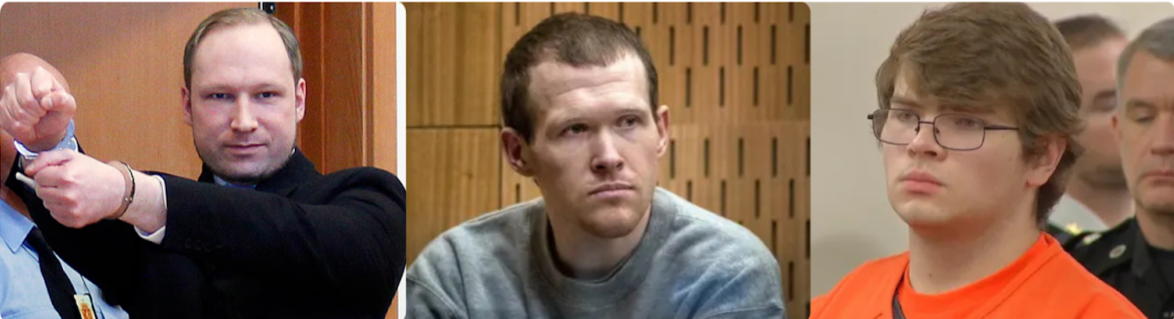
Image above: Anders Breivik (left), Brenton Tarrant (middle), and Payton Gendron (right)
Anders Breivik (Norway, 2011)
On July 22, 2011, Anders Breivik executed a two-stage terrorist attack that killed 77 people in Norway. He first detonated an ammonium nitrate car bomb in Regjeringskvartalet, Oslo’s executive government quarter. He had constructed the bomb by purchasing large amounts of fertilizer. The explosion killed eight people and damaged government buildings.
Breivik then traveled 38 kilometers to Utøya Island, where he arrived disguised as a police officer. The island was hosting a Labour Party youth camp, and Breivik opened fire on the attendees, ultimately killing 69 people. During the massacre, he called the police to surrender, stating: “Yes, hello, my name is Commander Anders Behring Breivik from the Norwegian anti-communist resistance movement. I'm on Utøya for the moment. I want to give myself up.” Despite this surrender call, Breivik continued firing on camp attendees after making the call.
His choice of target was deliberate. Breivik believed the Labor Party had failed to prevent the encroachment of "cultural Marxism” and a “Muslim takeover” of Norway. In his manifesto, Breivik extensively discussed the Great Replacement theory as one of the primary motivators of his attack, framing his violence as a defensive response to demographic change. This framing, that progressive politicians are traitors enabling replacement, would become a recurring theme in subsequent white supremacist attacks.
Brenton Tarrant (New Zealand, 2019)
Eight years after Breivik’s attack, Brenton Tarrant carried out a meticulously planned assault on two mosques in Christchurch, New Zealand. Originally from Australia, Tarrant had moved to New Zealand on August 17, 2017, and began preparing for his attack within days of arriving. On March 15, 2019, he put his plan into action.
Before leaving for the first target, Tarrant posted a 74-page manifesto titled “The Great Replacement” to the online platform 8chan, directly invoking Camus’ theory and explicitly referencing Anders Breivik as inspiration. He had also inscribed the names of other white supremacist terrorists and historical figures on his weapons, creating a visual tribute that would be captured on camera. Wearing a helmet with a mounted camera to livestream the attack, Tarrant arrived at Al Noor mosque and opened fire on worshippers during Friday prayers, killing 42 people.
After the first attack, Tarrant drove 5 kilometers to Linwood Islamic Centre, where he killed an additional seven people. Police apprehended him while he was en route to a planned third target. In total, he killed 51 Muslim worshippers, targeting them specifically because of their religion and what he perceived as their role in “replacing” white New Zealanders. The livestream footage and weapon inscriptions became key elements that future attackers would imitate, transforming Tarrant’s methods into a template for future violence.
Payton Gendron (United States, 2022)
Three years after the Christchurch attack, Payton Gendron executed an attack that was heavily inspired by Tarrant. On May 14th, 2022, Gendron drove 3 hours from his home to a Tops grocery store in a predominantly African American neighborhood in Buffalo, New York. He specifically chose this store because of the area’s significant Black population, targeting African Americans whom he viewed as participants in the alleged replacement of white people.
Following the established pattern, Gendron posted his manifesto two days before the planned attack, then publicly shared his plan for the attack 30 minutes beforehand on Discord. In his manifesto, he explicitly mentions Tarrant as his main inspiration and gateway into online extremism and white supremacy. Echoing the message of previous attackers, Gendron wrote: “The truth is my personal life and experiences are of no value. I am simply a White man seeking to protect and serve my community, my people, my culture, and my race.” This framing, presenting mass murder as selfless services, mirrors the language used by both Breivik and Tarrant, showing how deeply he internalized the justifications developed by previous attackers.
Like Tarrant, Gendron wore a helmet-mounted camera to livestream the violence, replicating what had made the Christchurch attack so widely viewed in extremist circles. Gendron began shooting in the parking lot before entering the store, where he continued firing at customers and employees. The attack resulted in 10 deaths. Police were dispatched to the scene on a “shots fired” call. Gendron was still in the grocery store when officers arrived. He later came out of the store to surrender himself.
Inspirations
The pattern of copycat behavior among lone wolf terrorists extends beyond shared ideology to deliberate replication of specific tactical and symbolic elements. Brenton Tarrant’s attack introduced two key innovations that subsequent attackers would adopt: weapon inscriptions and livestreaming. By inscribing the names of white supremacist terrorists and historical figures on his firearms, Tarrant created a trend in extremist violence that would be captured and circulated online. His decision to mount a camera on his helmet and livestream the massacre transformed the attack into viral propaganda designed for maximum online consumption.
These elements spread rapidly through extremist communities. Examples of this are the October 2019 attack in Halle, Germany, and the August 2019 murder and attack at the Al-Noor Islamic Centre in Bærum, Norway. Payton Gendron directly replicated Tarrant’s approach, wearing a helmet-mounted camera during his Buffalo attack. The practice of inscribing names on firearms became a symbolic gesture adopted by multiple attackers, each adding their own tributes to the growing list of extremist “martyrs.”
Within online forums, users praise these attackers for their “bravery” and “sacrifice,” framing mass murder as a selfless act to “save the white race.” This valorization transforms criminal acts into heroic narratives, lowering psychological barriers for potential future attackers. The community doesn’t just consume this violence passively, but they celebrate it, analyze it, and encourage others to take similar action. This creates a culture where terrorism is treated as a contribution to an imagined racial struggle.
Policy Challenges and Reform Efforts
The connections between these attackers, while individually subtle, create dangerous patterns that enable the spread of extremist violence. These links allow potential attackers to draw both inspiration and guidance from previous attacks, gradually normalizing the idea of mass murder as political action. The timing of manifesto releases expresses this: attackers consistently post their documents minutes before beginning their violence, leaving law enforcement with no time to intervene.
The difficulty of detection stems from the nature of these relationships. Because connections are ideological rather than operational, traditional counterterrorism approaches prove inadequate. Surveillance typically focuses on monitoring communications between group members, tracking funding flows, or infiltrating organizational structures. “Lone wolf” terrorists, however, radicalize through passive content consumption and one-way inspiration from previous attackers. They develop their plans in isolation while drawing from a shared playbook distributed through manifestos and online discussions. Anonymous accounts allow users to develop violent fantasies without revealing their identities, making early intervention extremely challenging.
International responses to this threat have varied dramatically. New Zealand acted with remarkable speed following the Christchurch attack. On April 10, 2019, less than a month after the massacre, Parliament passed comprehensive gun reform legislation banning semi-automatic weapons. Prime Minister Jacinda Ardern, who had received Tarrant’s manifesto via email before the attack, led this effort while simultaneously restricting public access to the manifesto itself to prevent its spread as extremist propaganda. Among the countries examined in this analysis, New Zealand stands out as one of the few to implement significant policy changes in response to a lone-wolf attack.
The United States has followed a different path. Calls for stricter online content regulation have been met with arguments that private companies, rather than the government, should bear responsibility for platform moderation. In June of 2025, lawmakers proposed the "Countering White Supremacist Extremism Act,” which aims to increase federal monitoring of white supremacist terrorism and establish requirements for social media platforms to moderate violent extremist content. However, the bill faces significant obstacles, including First Amendment concerns about government regulation of speech and resistance from technology companies wary of both liability and implementation costs.
Conclusion
The evidence demonstrates that the term “lone wolf” terrorism is misleading. While these attackers operate without formal organizational structures, they are deeply embedded in ideological networks across online platforms, manifestos, and symbolic gestures. From Breivik’s manifesto popularizing the Great Replacement theory as an actionable ideology, to Tarrant’s livestream and weapon inscriptions, to Gendron’s direct replication of these methods, the pattern is clear: these terrorists are connected through shared beliefs, online communities, and deliberate imitation.
Addressing this threat requires recognizing these invisible connections and developing policy responses that disrupt ideological radicalization while respecting free speech protections. As New Zealand’s swift response demonstrates, action is possible when political will exists. However, breaking the cycle of inspiration and violence will require sustained international cooperation, meaningful platform moderation and accountability, and, most importantly, confronting the reality that internalized racism creates the stereotype that terrorists are non-white and work in organized groups.